Hyperbaric oxygen & the injured brain

Oxygen is medicine. The brain can be repaired — even years later.

Across nine studies — three randomised trials, one of them double-blind and sham-controlled — hyperbaric oxygen produced measurable, scan-confirmed improvement in injured brains. Not fresh injuries. Injuries one to five years old. Here is the evidence, honestly laid out, with every claim traced to a real paper.

9
Studies in the file
3
Randomised trials
1
Double-blind sham RCT
1–5 yrs
Post-injury, still improved
What it actually is

Established medicine, aimed at a newer question

HBOT means breathing 100% oxygen inside a pressurised chamber. The pressure dissolves far more oxygen straight into the blood plasma than ordinary breathing can — reaching tissue the circulation can no longer fully supply.

Already standard care

FDA-recognised and used worldwide for carbon-monoxide poisoning, decompression sickness (the bends), arterial gas embolism, radiation-injured tissue and non-healing wounds. In 2013 the FDA added arterial occlusion.

The newer frontier

The studies here look at HBOT for the brain — traumatic brain injury, post-concussion syndrome, PTSD, stroke and cognitive decline. This is the contested edge, and it is where the honest reading matters most.

The striking finding

Much of the evidence treats chronic injury — patients enrolled one to five years after the event, well past the usual window for spontaneous recovery — and still shows measurable improvement.

Five things the oxygen does

How HBOT acts on the brain

Full mechanisms →

The reviews converge on one idea: HBOT is not just "more air." Cycling oxygen up and letting it fall acts as a biological signal that switches on the body's own repair programs — and it works on the damage itself, whatever caused it.

1 · Brings swelling down

High oxygen tension gently constricts cerebral vessels — lowering pressure inside the skull — while the tissue stays fed through oxygen dissolved in plasma. A paradox, but a well-described one.

Hyperoxic vasoconstriction · Shahid 2025; Ding 2014

2 · Restarts the cells' engines

Mitochondria resume ATP production; the anti-apoptotic protein Bcl-2 rises and pro-apoptotic Bax falls — tipping cells that were headed for death back toward survival.

Mitochondrial rescue · Bin-Alamer 2024

3 · Grows new blood vessels

Angiogenesis lays down fresh microvasculature into starved tissue, so oxygen keeps arriving after the chamber door opens — not just during the session.

Angiogenesis · Bin-Alamer 2024; Ding 2014

4 · Grows new brain wiring

Neural stem cells mobilise via Wnt-3 and VEGF; GAP43 and synaptophysin rise — the molecular substrate of new connections. This is what regaining a lost ability requires.

Neurogenesis & synaptogenesis · Bin-Alamer 2024

5 · Calms the damage

It dampens the neuroinflammation and oxidative stress — the HIF / NF-κB cascades — that keep injuring the brain after the first blow lands.

Reduced inflammation · Gottfried 2021; Shahid 2025

The physics underneath →

Why does pressure matter? Henry's law: dissolved oxygen rises in direct proportion to pressure — the fraction with no ceiling. See the diagram.

How it works
Try it yourself

Turn up the pressure. Watch the oxygen reach further.

Ordinary air fills your red blood cells to ~97% — the carrier is already full. Pressure forces the extra oxygen to dissolve free in the plasma, where it diffuses into tissue the blood cells never reach. Drag the dial and see it happen.

Live · Henry's law each dot = a patch of brain tissue  ·  red line = the capillary
capillary tissue edge tissue edge
1.0
Pressure · ATA
653
PaO₂ · mmHg
2.0
Dissolved O₂ · mL/dL
Tissue reached
1.0 ATA
1.0 · sea level1.5–2.0 · brain protocols3.0 · max

Or just hold the button

Press and hold to ramp the chamber up to a therapeutic 1.8 ATA — the way a real session pressurises — and watch the tissue above light up as the oxygen reaches it.
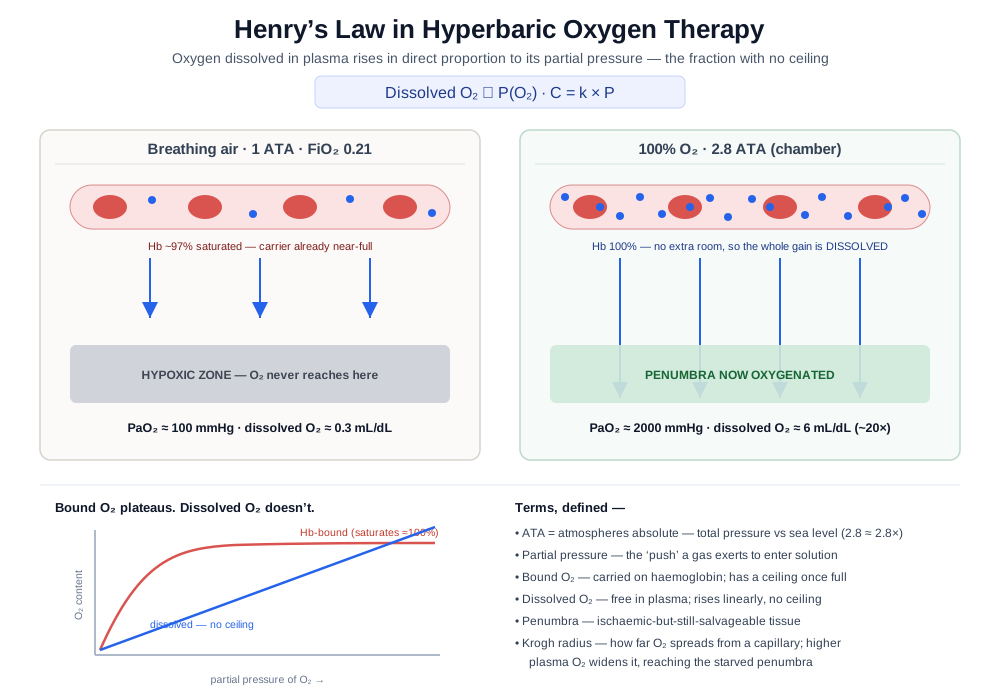
Henry's law diagram: at 1 ATA on air oxygen reaches only near the capillary and a hypoxic zone remains; at 2.8 ATA on 100% oxygen dissolved oxygen diffuses far enough to reach the starved penumbra.
Henry's law: C = k × P. Bound oxygen plateaus; dissolved oxygen doesn't.

Figures are physiological approximations — PaO₂ via the alveolar gas equation at FiO₂ 1.0; dissolved O₂ by Henry's law (0.003 mL/dL per mmHg); diffusion reach ∝ √PaO₂. Illustrative of the mechanism, not a dosing guide. Sources: Gottfried 2021 (Biomolecules); Weaver 2025 (Scientific Reports).

Is this you?

You were told there was nothing left to try. The research says otherwise.

The people in these studies weren’t abstractions — they were parents’ children, veterans, stroke survivors, someone still not right months on. Find the one that sounds like you, or like the person you’re carrying.

Who this is for — the full page →

Did you know

Eight things worth knowing

Follow the money

Oxygen has no patent — so no company profits if HBOT is proven, and no one writes the cheque for the definitive multi-centre trial.

The hardest test

The strongest study (Weaver 2025) was double-blind and sham-controlled — the design built to fool the placebo effect. Real oxygen still won.

Not too late

These trials treated injuries one to five years old. Brains still improved. "It's too late now" is not what the research shows.

Not fringe

HBOT is already FDA-accepted standard care for CO poisoning, the bends, radiation injury and wounds that won't heal.

Under FDA oversight

Harch's 2020 trial ran under FDA IND #113823 with full US Army human-research approval. This is regulated medicine.

Scans, not opinions

In 30 veterans, SPECT brain scans normalised in 75% of abnormal regions — and suicidal ideation fell (Harch 2017).

Pooled and significant

Across 250 patients, memory improved by a mean difference of 10.13 and attention by 7.99 (both p < 0.00001).

A quiet double standard

The one accepted neuro-repair treatment — cooling — helps ~25% and still fails for nearly half, yet is called "standard," not "experimental."

The evidence, in tiers

Strongest designs first

Full evidence table →
Double-blind RCT

Weaver 2025

Scientific Reports. Real hyperbaric oxygen beat sham on the primary brain-injury symptom score — mean difference 7.0 (95% CI 1.7–12.3, p = 0.01), plus gains in olfaction, anxiety and sleep.

Meta-analysis

Shahid 2025

Four studies, 250 patients pooled. Large, significant gains in memory (MD 10.13) and attention (MD 7.99), plus executive function, processing speed and motor skill.

Randomised crossover

Boussi-Gross 2013

PLoS ONE. 56 people, 1–5 years after mild TBI. Cognition and quality of life improved after HBOT — and SPECT scans lit up to confirm it wasn't imagined.

Read honestly

Sample sizes are modest, several designs are crossover, one central cohort is retrospective, and the optimal dose isn't yet standardised. These are the ordinary limits of an evidence base in transition — the field's own caveats, not evidence of absence. We list them in full on the evidence page.

"HBOT can induce neuroplasticity leading to repair of chronically impaired brain functions." — Boussi-Gross et al., PLoS ONE, 2013
Go to the sources

Check it yourself

Full directory →
Stand with the argument

Oxygen versus nothing that acts on the injury

The honest alternative to trying HBOT isn't a rival treatment — it's supportive care and waiting. This site exists so families and clinicians can weigh that choice with the real evidence in front of them. Add your email and we'll keep you posted.