HBOT's benefit is not merely extra oxygen delivered. The controlled swing between high oxygen and normal oxygen is itself a biological message — it switches on the same repair programs the body runs during a shortage, but without the shortage. Here is the physics, then the biology, step by step.
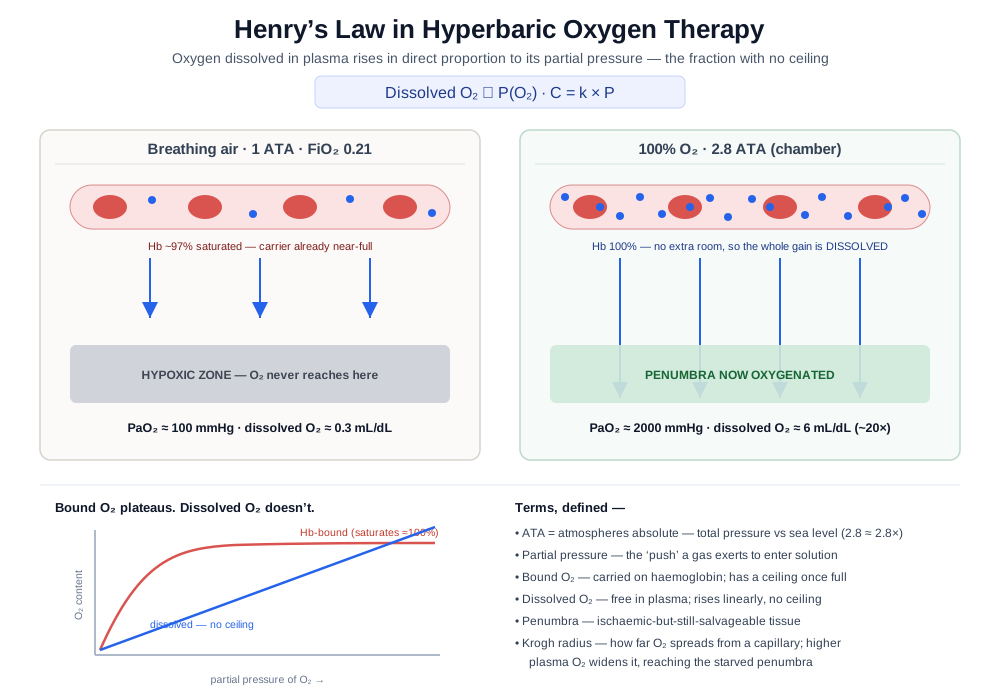
Henry's law says the amount of a gas dissolved in a liquid is directly proportional to the pressure of that gas above the liquid: C = k × P. Breathing ordinary air, haemoglobin is already about 97% saturated — the oxygen-carrier is nearly full, with little room to give.
Raise the pressure and the extra oxygen has nowhere to go but dissolved, free in the plasma. Bound oxygen plateaus; dissolved oxygen keeps climbing with no ceiling. At 2.8 ATA on 100% oxygen, dissolved plasma oxygen rises roughly twenty-fold — from about 0.3 to about 6 mL per dL — enough to reach the starved tissue (the penumbra) that red blood cells never quite arrive at.
The Krogh radius. Higher plasma oxygen widens how far oxygen can spread from each capillary — so the same vessels suddenly reach cells that were sitting just out of range.
Give the body a burst of very high oxygen, then let it return to normal, and the cells respond as though they had just survived a shortage — mounting the same adaptive repair response, but with none of the damage a real shortage causes.
This is the counter-intuitive engine of the whole therapy. The signal that normally says "we were starved of oxygen, start repairing" can be triggered by the withdrawal of a surplus. So HBOT recruits the body's own recovery machinery — the machinery evolved to handle hypoxia — while actually flooding the tissue with oxygen.
Source: Gottfried 2021 (Biomolecules); Bin-Alamer 2024 (Frontiers in Neurology).
Six documented pathways, drawn from the two dedicated review papers and reinforced by the mechanistic sections of the trials. Crucially, they are cause-agnostic — they act on the shared downstream damage of injury, not on the specific event that caused it.
The cell's energy factories resume ATP production. The anti-apoptotic protein Bcl-2 is upregulated and pro-apoptotic Bax downregulated — shifting cellular fate away from death and toward survival. New mitochondria are also made.
Bin-Alamer 2024
Neural stem and progenitor cells are mobilised through Wnt-3 and VEGF/ERK signalling — the recruitment of new neurons into the repair effort.
Bin-Alamer 2024
Elevated GAP43 and synaptophysin — the molecular substrate of new synaptic connections. New wiring is precisely what regaining a lost ability requires.
Bin-Alamer 2024
New microvasculature forms into hypoperfused tissue, sustaining oxygen delivery beyond the treatment session — the gains don't stop when the chamber depressurises.
Bin-Alamer 2024; Ding 2014
HBOT modulates the transcription-factor cascades — HIF, NF-κB and their downstream mediators — that govern the secondary injury unfolding after the first insult.
Gottfried 2021; Shahid 2025
A paradox worth pausing on: high oxygen tension constricts cerebral vessels, lowering intracranial blood volume and pressure — while tissue oxygenation is maintained through dissolved plasma oxygen. Less swelling, no starvation.
Shahid 2025; Ding 2014
The significance of this model is that all six pathways operate on the shared downstream pathophysiology of neural injury — mitochondrial failure, the oxidative cascade, neuroinflammation, oedema, disrupted connectivity — rather than on the specific initiating event.
That is why a treatment studied in traumatic brain injury also has a coherent rationale in post-concussion syndrome, PTSD, ischaemic stroke and cognitive decline. A hurt, swollen, oxygen-short brain looks much the same downstream whatever hurt it — and HBOT acts there, on the injury itself.
None of this proves outcome on its own — mechanism and clinical benefit are different questions. But a therapy with a detailed, replicated biological account sits in a different category from something that merely "seems to help." The mechanism is the reason the clinical signal is believable.